In some ways 2020 is looking very patriotic. A group of people, feeling that their government has been exploiting and extracting wealth and value from them, seems to have had one too many lives taken by the ones they render taxes to to quietly continue on.
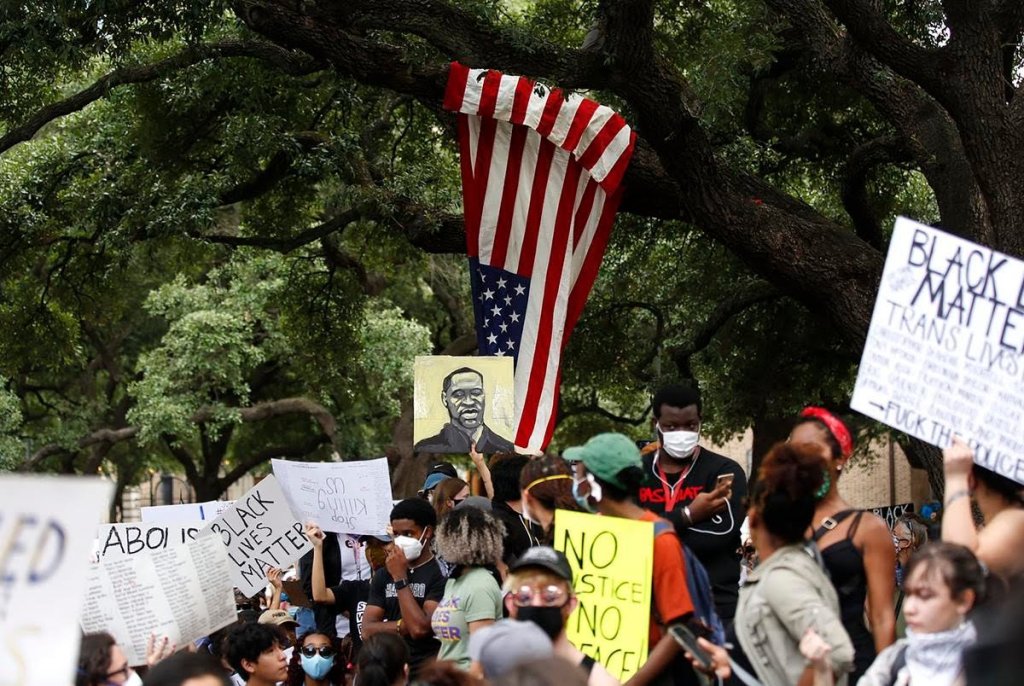
Weeping and grief and frustration, then uprising. The expirement continues to be messy, with moments and glimpses of wrestled beauty as bluffs again get called.
As the dominoes fall, the societal contract has been examined and deemed broken (or non existent in the first place).
Examination, demonstration, calls for changes in legislation.
I can imagine that when the American Revolution came, opportunity for introspection for Britain would have come along as well.
As the Crown was looking at itself, trying to better understand what it was and had been becoming, the colonies were also engaged in examining and defining their own identity.
Gerald Horne’s The Counter-Revolution of 1776: Slave Resistance and The Origins of the United States of America gets deep into the identity crisis the colonists were wrestling with.
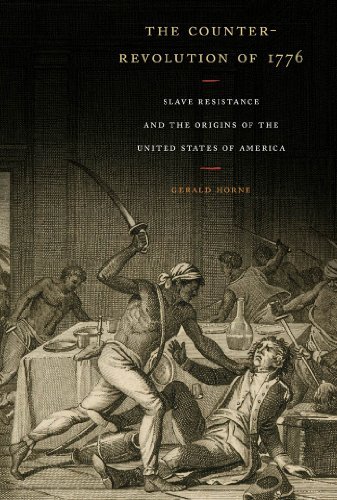
Old adversaries had to find a way to form a new, unique identity. Enmity that existed between white ethnic and religious groups (Catholic and Protestant schism), which had followed them over to the Americas, had to be cooled.
They were facing a dilemma of unity or possible destruction. Horne’s book records correspondences between colonial leaders. A rebellion by the enslaved Africans forced to inhabit the Americas could potentially, credibly, cripple the colonial branching. Cost benefit analyses were being run.
As the revolution came, the threat to the colonies was compounded by Dunmore’s Proclamation, in which the British offered freedom for slaves owned by those rebelling against the Crown if they could reach British lines.
(It should be acknowledged that this Proclamation, like the Emancipation Proclamation less than a century later, was political, and calculated, and complicated.)

What to the slave was the Fourth of July? What to their descendants is its Nation’s anthem? What were the slaves to the man who penned the song? What is it all to their descendants now?
These are all questions that members of this nation have wrestled with for decades in one way or another.
For the sake of this writing though, what might the Fourth of July be to the Christian?
Arguments have been made that the American Revolution was a justified (or just) war and at least one controversial case for colonialism in general has been made.

But did the resulting nation look like Christ?
I acknowledge that this writing may in some ways be outdated. I do not hear the same rhetoric that I used to. I have also chosen different teachers and scholars and pastors to learn from in the last few years which could in part explain that.
But I know in the past, in certain evangelical circles (and I think this may still be true today), there has been no or little allowance for critique of a religious national identity. Certain pockets have been totally binary, all or nothing, choose a side. America is a Christian Nation (confess and pledge allegiance) or you are neither really American or Christian (depart, we know ye not).
There has been little room for challenge. As if Jesus did not critique the religious establishment, challenging their applied interpretations of what God was like.
Certain characteristics of God had been made known to the Jewish people that Jesus was a part of. The religious leaders tended to magnify certain aspects and minimize others.
The wrath of God towards sinners seemed to be an aspect fully embraced (at least for the testing) when a woman who was caught in adultery was brought before Jesus.
Provision and protection for the poor and needy seemed to be lacking though, when it came to the selling of sacrificial animals.
There was a clash between what the establishment was selling and the purpose of the institution in the first place. This disparity cuts to a missing of the purpose of the relationship God established with Abraham long ago.
There was a misrepresentation of God that Christ felt compelled to address in context.
Christ was continuing the tradition modelled by the Father in the Prophets.
“I hate, I despise your religious festivals; your assemblies are a stench to me. Even though you bring me burnt offerings and grain offerings, I will not accept them. Though you bring choice fellowship offerings, I will have no regard for them.
Amos 5:21-22 (also see Micah 6:10-11)
Jesus and the Father critiqued the religious establishment in context when the religious leaders were off the mark. We also need to use discernment, informed by Scripture with an emphasis on Christ, and do the same.
It is both Christlike and Godly to correct or challenge in love. It is an act of iron sharpening iron.

So if we learn about Jesus, the Son of God who died for the salvation of sinners, and then we learn about violence and uneven scales used to expand the land grabs and churn capital to turn profit from forced labor that would come to make America, and someone tells us that one is a representation of the other, caution, skepticism, and even challenge (in love), may be warranted.
The pillaging was powered largely by Christians who often interpreted their success as a reenactment of the Israelite conquest of Canaan. Some pastors see George Washington as America’s Joshua. Moving from Europe to the Americas might have been interpreted as their own exodus. (But many biblical scholars can read the Canaan conquest stories in Joshua and understand that they were not meant to convey for their audience a militant, colonialist attitude. Even Jesus knew these stories from his ancestry and still commanded enemy-love, insisting along the way that he was not contradicting but embodying the Law and the Prophets.)
Shane Claiborne and Chris Haw – Jesus For President (pg. 171 – “The Imperial Baptism Continues”)
Seeing the contrasts, and calling them out helps us to recognize that our kingdom is not of this world, and to recognize the great falling shorts of this nation and its leaders when compared to the Kingdom of Heaven and its King and Christ.
As we call out the brokenness and inconsistencies, we can and should do so with the hope and longing that wickedness, and sin, and the injustices of the land (which we inhabit for a short season, but which is not our ultimate inheritance as is), cease, so that our actual Kingdom where our actual allegiance should be pledged in primacy, can be furthered in a semblance of just peace.
Oh it’s murder and it’s foul
Yes it’s ugly and it’s vile,
But this town’s
The only home I’ve ever known.
Born a child, the exile,
Just might be here for a while
So I seek the peace, the peace of Babylon
…Oh Babylon oh Babylon
Good God have mercy on thee!
And crown thy good
With brotherhood
From sea to shining sea
…
Micah Bournes – “Patrick Henry/Make it Beautiful”
Open and critiquing eyes free us to keep things in perspective:
Yes I love the Kingdom
More than I love my nation,
Yes I love my neighbor
More than I love his papers.
KB – “Long Live The Champions” ft. Gabriel Rodriguez EMC, and Yariel
Glory, hallelujah,
On Jordan’s stormy banks I stand,
Glory, hallelujah,
I’m longing for the promised land.
Crowder – “Promised Land” ft Tedashii
We become less satisfied with the mud pies in the street because we hear glimpses of what a holiday at sea could be, and we know that its value is not from an accumulation of wealth, but from love sacrificing for the beloved to call others more fully into the identity God speaks over them.
Christ wept over Jerusalem because, in knowing God, he could see the Father’s heart for her and how she was falling short, and how she could be saved and step into her originally intended identity if she could recognize that Christ was God with them and God looked like Christ. He wept because she was nowhere near where she needed to be or could be in the eyes of God.
The Fourth of July may be a reminder that there is work to be done while we are here, both for the sake of the earthly city we inhabit, and for the name of Christ that is to be known in it by his people.
In some ways the political intercessory work of non Christian organizations and movements have looked like Christ, even and while missing marks of holiness.
A segment of the church has been involved in social and political intercessory work to address injustices in this land even during its early labor pains. But, abdication of the privilege to be Christ like in affirming the dignity and value of marginalized lives (a society’s least of these) by the church, in opposition to the economic or governmental authorities of the day, has ceded the field of social activism for change to pagans in recent years.
(Christ used the word Gentile in the way that I am meaning to use the word pagan here, for those outside of the family of faith (at the moment). I understand that different translations can complicate this… and Jesus probably had so many layers on his words when he spoke, so maybe I’m not using it in completely the same way… Biblepages.net provides some nuance as I’m sure other commentaries and concordances do too.)
In Charlottesville in 2017, Dr. Cornel West believes he and a group of faith practicing people could have been assaulted and completely “crushed”, if it had not been for the shielding provided by those more identified with anarchy and anti-fascism than with any Christian religious tradition.
So, what to the Christian might the Fourth of July be?
Perhaps an acknowledgment that the nation (like all nations of the earth really) is messy, influenced by broken people, and has in itself an opportunity for constant change and growth that critical analysis can bring.
The holiday may serve as a reminder that this land is not our home, but while we are here, we can weep over it, love those in it, challenge its misclassifcation, and we can work to make it more beautiful.
The Bail Project – Help make freedom free.
So, there was much blood shed this Fourth of July weekend.
One icon of the Fourth is the firework.
One of the sacred items of this holiday is the explosive, in honor of the bombs bursting in air. Consider that for a moment.
Perhaps then, the bloodshed is not a coincidence.
Perhaps a prince of violence, stooping over the land, is roused by the honor given physical war, and battle, and bloodshed birthed from condemnation and separation and independence.
Perhaps in its looming over us like Mars, it then hears songs and bombs directly or indirectly booming in its honor, and, upon hearing, nudges people to produce more.
War celebrated. War replicated. Fruit after its own kind, watered by the glory given the spilling of blood.
Perhaps the Fourth to the Christian should be a time of lament. For the survivors and loved ones of those who suffered voilence this weekend, it certainly will be.
In some aspects, it continues the tradition of violence that has flared up during and in the days surrounding many Fourths before.
 Festival of Booths
Leave a comment