Eshon Burgundy – “Pray”
Let no debt remain outstanding, except the continuing debt to love one another, for whoever loves others has fulfilled the law. The commandments, “You shall not commit adultery,” “You shall not murder,” “You shall not steal,” “You shall not covet,” and whatever other command there may be, are summed up in this one command: “Love your neighbor as yourself.” Love does no harm to a neighbor. Therefore love is the fulfillment of the law.
Romans 13:8-10
In my previous post “If (Primary) Justice Was Done”, I looked at a form of justice that, if practiced with earnest and self-sacrifice by the Christians who were in the early and adolescent United States of America, could have preempted the creation of highly racialized laws which have contributed to the Laments in Midlothian.
This week I’ll revisit an earlier post in this series about fear. In the original post I considered how fear will likely be used to justify the killing of Jemel Roberson. This week I will consider how a prophetic lens of faith and honor may have brought a prophetic letter of love to Midlothian, rather than a lament.
Of Fear, and Feared Men
Of Faith, and Prophesied-Over Image Bearers

So many we swore there is no way in hell
we would see them in heaven
~(Until we put on love and new prophetic eyes…)~
they will be there
We will be there
with a song on our lips
and our eyes full of faith
and we’ll sing
How amazing, is grace
Micah Bournes – “Freakshow” (~adapted~)
Just as I have come to learn that justice is more than just rectifying or correcting wrongs, I have learned that there are at least two levels to prophecy and the prophetic.
Just as I have learned that justice has a beauty and a purpose that does not require original offense or brokenness, I have learned there is an aspect of the prophetic that is not tied to apocalyptic forecasting.
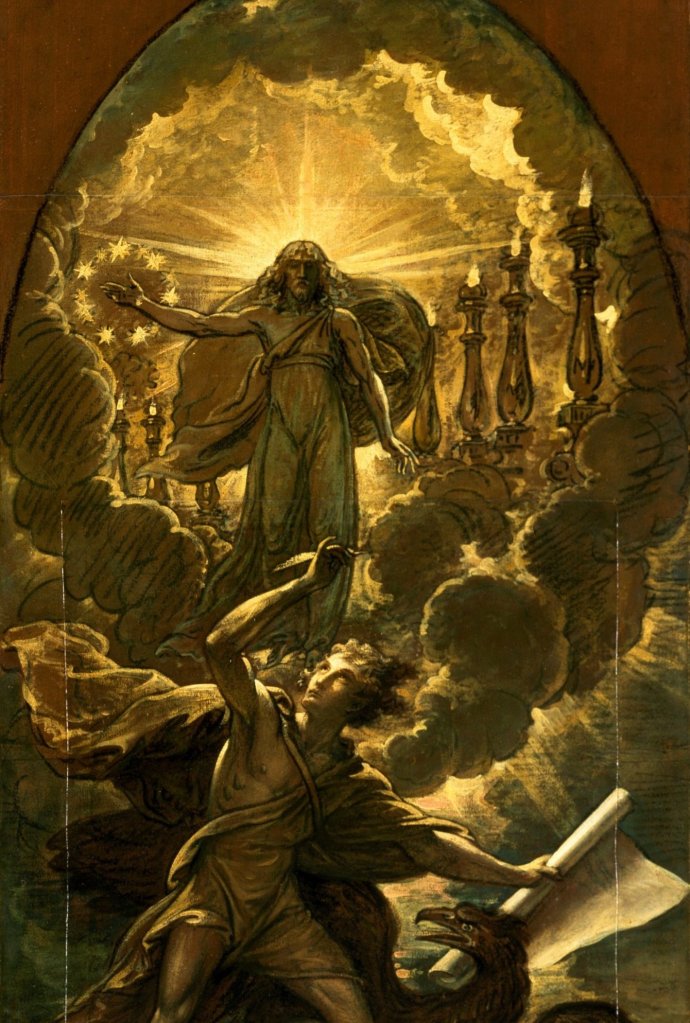
Image source: Wikimedia Commons
Biblical, Christian prophecy is also about tapping into God’s thoughts in the present, over a person, or occurrence.
A few years ago, leadership in my local faith community began to encourage and instruct us in practicing the prophetic.
Paul’s letter to the church in Corinth gave us some guardrails:
But the one who prophesies speaks to people for their strengthening, encouraging and comfort.
1 Corinthians 14:3
So we made sure to give words that were strengthening, encouraging, and comforting.
We would look at Psalm 139:17-18:
How precious to me are your thoughts, God!
How vast is the sum of them!
Were I to count them,
they would outnumber the grains of sand—
when I awake, I am still with You.
Psalm 139:17-18
and believe there are certain things God has in His heart for everyone, and that some of those things can only be made known “just so” through one unique individual, like how different angles or sightlines bring different perspectives to artists who then draw somewhat differing pictures of the same honored, and lovingly crafted object.
So we would ask God, “what do You think of this person? What is something You want to say, that can only be said through me in light of the Cross?” And we would engage in prophetic prayer from a place of honoring for those in our company.

This is a practice we try to carry with us to people outside of our faith community as we have the chance. We try to see them through a lens of honor, seeking some aspect of God’s heart of love for them. We partner our imagination with what God has said in His word, and what He may speak in prayer through the Holy Spirit to declare some iota of the value He sees in them.
This is faith-in and prophecy-over image bearers, instead of fear-over feared people.

The spirit of fear will often lead our imaginations in unholy, unrighteous ways, thinking worst-case scenarios, casting people in negative light, imagining them as increasingly evil and far from God (and more importantly, as God being far from them). We hold their sins (or potential sins) in perfect focus and upon them we will meditate some/all of our day/night.
The prophetic can bring us into a place of seeing the value and worth God sees in individuals, pieces of the plan He might have for them through His redemption and intercession.
When we practice seeing through this prophetic lens, tzadeqah justice becomes more and more natural.
As we work to take thoughts captive (2 Corinthians 10:5) we begin to look for targets to bless and give hope to.
Way I look you probably think you get some dope from me, yo
But run up on me funny though, get some hope from me.
Eshon Burgundy – “Free Hope”
If a prophetically inspired tzadeqah ruled in the land as an element of the law of love, we would not glorify the violence of the warrior. We would not romanticize violence.

Those trained in lethal force would be more than equally trained in de-escalation, meditating on peaceful resolutions, seeing people as targets for peace and bright futures, not bullets and chokeholds.
There would not be the extracurricular Bulletproof Warrior police trainings, where officers like Jeronimo Yanez (who can be seen just after fatally applying gun violence to Philando Castile, bathed in fear, as if the roaring lion slathered him up with a fear drenched tongue and then left him cold with the consequences. I’ve decided against linking to that one), are taught “killology”… And then sometimes, after having learned the theory of killology, they may apply ultimately lethal violence to a registered gun owner, with his girlfriend and child in the car, fatally wounding him, with them there, while the now dead man was attempting to comply (like Jeronimo Yanez did, when he fatally applied gun violence to Philando Castile, and can then be seen, drenched in the fear, and trembling in the after effects).
I probably wouldn’t have written Premeditated. And Jason Stockley would not have inspired me to do so.
And we probably wouldn’t spend as much time as we may in some Christian circles, discussing the words for “kill” and “murder” in the original languages… to (potentially) justify the killing that we ponder… and practice the mechanics of… and that we meditate on… “just in case”.
And with less firearms out there the number of accidental injuries and deaths and the trauma of that aftermath would be greatly reduced.
And the economic factors, intentionally perpetuated, that breed economic insecurity and violence-laced underground and black market economies would no longer underwrite the leading gun violence statistics.
And that war on drugs might not have felt so much like war on the poor, as Propaganda put it in his feature on Lecrae’s song “Gangland”.
There probably wouldn’t be some children growing up looking at police officers through a lens of fear (because of the violence used against their loved ones).
And the tax payers lauding fiscal responsibility would not have to subsidize compensation and court settlements for police misconduct and violation of civil rights, and basic decency.
Had tzadeqah (inspired by a prophetically honoring society) instead of fear ruled the day, had officer Ian Covey meditated and trained more on situational awareness to de-escalate (so everyone goes home), instead of intensify force, he may have listened to the voices crying out that Jemel Roberson was a security, and may not have shot him those multiple times.
And we wouldn’t have to talk about the difference in outcomes for good guys with guns based on race.
Maybe, after not killing Roberson, and not seeing him through a lens of fear, Covey would have been the first officer to commend Roberson on his not killing someone, and containing the situation.
Maybe Roberson would have joined the ranks of a law enforcement department that saw black and brown citizens through a prophetic lens of potential greatness and not potential threat or pathology. And Roberson and Covey would have been great friends and partners.
Maybe the altercation that led to the tragic events that night would have never happened.
Maybe if America’s prosperity wasn’t in part bought with gunpowder and lashes of enslavement, then generational paranoia would not also be our inheritance. And then the gun death total of 39,773 people in 2017 would have been much lower.
2016 saw a record high number of guns manufactured in the US. These guns may not all have been manufactured from a spirit of fear (many gun owners use them for hunting/sport), but I’m pretty sure they weren’t made out of a prophetic heart of esteem and honor for neighbors.
Maybe we wouldn’t still be asking “who is my neighbor?”
What if law and order meant the law of love and honor?
Maybe a law enforcement officer would not have likely saved a message about threatening violence and death to “love to laugh”.
Maybe the words “We only kill black people, right?” would not have been used by a police officer, to calm a white motorist and assuage her apprehension over complying for fear of violence.
Maybe we don’t have to have deep debates about forgiving those who killed someone’s loved ones based on race. Maybe race relations in America don’t feel like a dysfunctional marriage (“Don’t All Wives Matter?” – See Propaganda’s “20 Years”, please).
Maybe Cain doesn’t kill Abel out of jealousy or fear that there is not enough of God’s affection for them both. Economic insecurity in light of a God of abundance. It is a tragedy. Maybe we realize that we are our sister’s and brother’s keepers and that our sister’s and brother’s are amazing, and beautifully and wonderfully made by God.
Maybe it’s not sheepdogs and sheep, or shepherds and sheep, but community members serving and protecting other community members through their positions in police departments as Sgt. Delmar Williams might put it.
Swoope – “TSNK”
And we don’t have to wrestle with our own tribalism?
And we resisted the lowly lion, and he would flee?
And I don’t write a Lament for Midolthian, but a prophetic letter of love, honoring its tzadeqah justice?
And we only gave our ear to the Lion that loves?
I wonder…
In the next post, I’ll conclude the series with a focus on the Lion who is Lord and on His love.
I know that these last two posts especially have painted some rather ideal “what ifs”. I know that the world we live in is complicated and complex and not as simple as my hopeful rhetoric would make it. I believe that faith in a God of love that would die for sinners should inspire us to raise our standards towards that level though, instead of lowering it find reasons to justify the cutting off of ears in Gethsemane.
While His Grace will meet us where we are, the greater glory is in growing to be where He is.
There’s a lot I ended up cutting from this post for the sake of word count/focus. I’ll drop some additional songs and articles here. I may pick some of these things up at a later date.
Bizzle – “Who’s The Man” perfectly shows how we can step into agreement with the lowly lion and condemn those who offend us in our imaginations, and then use our imaginations to visit violence upon them. It does take an unexpected turn (no further spoilers).
nobigdyl – “enemies?” and Bizzle – “No Hate” ft Bumps INF both recognize that there are those that will view us as enemies for stands that we take, but that we are called to respond in a different, more prophetic and Christ-like (Christian) way.
Propaganda – “Cynical” ft Aaron Marsh and Sho Baraka points to potential problems that may occur when critiquing systems and individuals we feel are not measuring up to a standard of righteousness we long for. It points out the flaws in the system, but also subtly offers warnings to us to not lose the prophetic eye of faith and love in our calls for change.
Some Articles and other posts:
The Gospel Light Watchmen’s post about Jesus and His justice. This should have been shared last week, but it’s influence is felt in this post as well.
This is linked above in the content of this post, but I also want to directly call out this message by John Kovacs from The Light – “Seeing What God Sees- Acts Series” which kind of formally launched and really reinforced our practicing of this prophetic at the local level.
“If Migrants Were Handguns” by John Pavlovitz at Stuff That Needs To Be Said
“God, Guns, and Country: The Evangelical Fight Over Firearms” by Eliza Griswold at The New Yorker
“Praise the Lord and Pass the Ammunition, Quantified” by Sarah Eekhoff Zylstra at Christianity Today
“White Supremacists Embrace “Race War”” at the Anti-Defamation League
“The Charleston Church Massacre (2015)” by Samuel Momodu at Black Past
 Festival of Booths
Leave a comment