
“How do you mend a broken world?
Give it a gift it could never earn,
Pour out a love, that it don’t deserve,
Send it a Son and a Savior. It was a silent night, A Holy Night”Crystal Nicole, “Silent Night” 116’s The Gift: A Christmas Compilation
.
Last month, on November 23, 2018, Reach Record’s 116 released a Christmas album The Gift:A Christmas Compilation, which is so definitely worth a listen. It’s got nice contemporary flows, vibes, and feels built on sacred truths. I could see “Joy” being played in a Gap commercial and get chills at the picture of heaven and nature praising in “Silent Night”.
I’ve been wrestling with, and so writing about, issues of race and justice. I’ve been sitting in on conversations about the history of race in, and before the United States. I’ve listened to discussions and debates about Christianity and social justice. I’ve been struggling with the reality that the enemy, that roaring, devouring lion, has so effectively capitalized on socioeconomic and racial (and ethnic) distinctions to divide man from man.
But as this Advent season is here, I’ve been reminded of how God, through Christ, has been working to unite people of diverse socioeconomic and racial (and ethnic) groups together in Christ, even before the incarnate Christ, Immanuel, God-With-Us, could utter a word.

*
Last year in my Christmas article “What God Feels Like” I plugged a number of songs, but I wanted to bring up Beautiful Eulogy’s “Immanuel” again. The song presents us with vignettes of both the supernatural and natural world’s wondering in curiosity and marvelling over the Incarnation of Christ. A few of these awe-inspiring glimpses are amplified in “Silent Night” by Crystal Nicole on The Gift: A Christmas Compilation referenced above:
*
“I hear the clouds speak, sing of His glory…
I see the sky part showing the Father’s heart…
I see the stars bow, Heaven is smiling down…
Making my wrongs right, bringing me Life on a silent night”
*
On the day of Christ’s birth, their is awe and wonder and joy. And invitation.
The Gospel of Luke recounts the angels coming to shepherds and announcing the birth of the Savior, the Messiah, in Bethlehem, in a manger. These shepherds seem to be working class. They have an occupation (shepherding). They are staying in the fields (I don’t know if maybe they lived in houses sometimes, and in fields at other times, and I’m not saying that they were or weren’t homeless, but some translations do say they were living in the fields nearby). They are not rich or famous or well known. They’re just shepherds, who work. They get their birthday party invitation. They hear that the Messiah has come, and they go to see Him.
As they do, their lives take a change (maybe one could say, another change). After experiencing Christ, they go and tell everyone. They shift the topic of discussion. Water cooler talk takes a sudden turn. Conversations are shaped by their encounter. (Luke 2:8-20)
*
“I think I found the King
I think I found the King
Over everything
Put Him over everything”
“We Three Kings” – 116 (ft Paul Russell, Lecrae, Abe Parker)
*
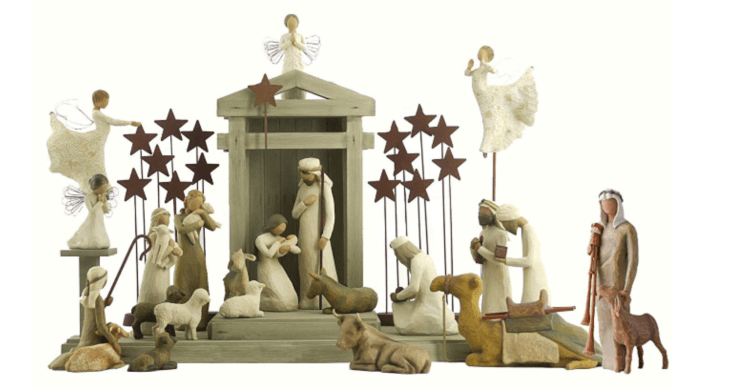
Nativity Set via Amazon.com
When I was originally brainstorming this post, I had a very specific picture in mind, and a very specific message I wanted to put out. I was picturing that classic nativity scene, with Mary and Joseph, Jesus in the manger, the animals, the shepherds and the Magi, often referred to as wise men and sometimes kings. I’ll be using the term wise men going forward.
So I went to the scriptures for a little direction. And… I did not find that perfect picture I was looking for.

FALSE?!?
The shepherds and the wise men are never recorded as being at the manger at the same time according to the Gospel accounts. The shepherds hear about, and see Christ on the day of His birth. And the wise men don’t see Christ until after he is born, possibly two years after (Matthew 2:1, 16).
The shepherds have come and gone, and they’ve spread word about their experiences (I imagine they even told their next door neighbors… except that, I don’t know if they had such things, because I don’t know if they had doors… because they’re staying… or living… in the fields… I don’t know, maybe they had tents or something? Or nomads maybe… Backpackers?). Mother and child (and Joseph) are no longer hanging out in the manger. The wise men will meet Jesus at a house (Matthew 2:11).
Scripture tells us that these wise men came from the east (Matthew 2:1). They were out of towners, foreigners. Their invitation was not as direct, at the one sent to the shepherds, but something like the supernatural manifesting its glory through natural phenomenon, maybe even guiding it, to use its spectacular potential for a specific divine purpose (Matthew 2:2,7,9,10).
The wise men receive the beautiful and somewhat vague invitation, and come to Jerusalem and ask about the newborn king of the Jews so that they can find and worship Him. Herod, who is the earthly and political king of the Jews at the time, hears about this and calls the scribes and teachers to get some answers. The teachers quote from the prophet Micah and point to Bethlehem (Matthew 2:6).
Interestingly, Herod doesn’t send his own people to try and find the child. Instead, he calls the wise men secretly and there is an exchange of information. They tell Herod of the timing of the star that they have followed. Herod tells them what he knows, and trusts them to report back to him once they see the child. This secret meeting could be a bit of statecraft between representatives of two different peoples. Herod is working to show favor to receive favor. Poltic[king] hard.
When the wise men do come before the child, in the house, they present their gifts of gold, frankincense, and myrrh. These gifts make it appear like these foreign men are wealthy.
Besides those material items, they also offer up good foreign relations with king Herod, because they do not report back to him as he had asked, being warned in a dream to go back home another way.
These wealthy foreigners were willing to give their material possessions, and, after encountering the Messiah, were willing to step away from a political relationship that may have required them to compromise their Christ.
Sometimes we too are called to walk away from relationships that may threaten the place of Christ in our lives.
The shepherds and the wise men came from two very different worlds. They came to know about, and then encounter Christ, in very different ways. Once they came before Him, their relationships with the people they knew before were changed.
This goes back to the heart of what much of my writing has been about, the longing to have divides crossed, to see peoples of diverse socioeconomic and ethnic and political backgrounds brought together before Christ as one, to be so affected by Christ, that He is taken into consideration above all and powerfully impacts all relationships.
A few days ago, R. Albert Mohler, president of the Southern Baptist Theological Seminary, released a report (which can be found towards the bottom of their page here) about the history of the Southern Baptist Theological Seminary’s involvement in slavery and racism in the United States. Many of those who appreciated the work for exposing this history were yet and still critical because the report lacked mention of the modern day impact of this history, and also lacked prescriptive suggestions for actions going forward. They ask the question, “how then shall we [all] live?” or possibly, “well now, what are you going to do about?” I think they have a point.
An underlying hunger in my writing is fueled by contemplations over how things could have been different… What if the church in America in much, much larger portion had really been the hands and feet of Christ, standing up for, and in defense of the least of these, of non-whites, of Native Americans, and Africans in America? What if the church, as a whole, had been a voice like John the Baptist crying “prepare ye the way of the Lord, make straight paths for Him”, and, “it is not lawful for you to [own people],” and spoke truth to power, and were willing to move to the margins, to survive on locusts and wild honey, instead of the wealth of the king’s or the state’s or the governor’s table? Or, like John the Baptist, had been willing to be arrested or even executed by the state for speaking truth to power. What if the church had, like Arwen declared in “The Fellowship of The Ring”:

“if you want [them] come and claim [them]!”
Image via Pinterest
, and embraced the discomfort because they had the Comforter? And weren’t so risk averse, but were daring in love and lived like “What Up’s Danger?” (from the first track of Spider-man: Into the Spider-verse soundtrack, “What’s Up Danger?” by Blackway and Black Caviar) or more aptly, like KB declares “Yes I love the Kingdom more than I love my nation. Yes I love my neighbor more than I love his papers” (on his fire single “Long Live the Champion”). And lived in the tradition of those written of in the Hall of Faith in Hebrews 11 who were living for another country. What if they had stood in the gap at slave markets, and refused to be chaplains on slave ships (“Precious Puritans” by Propaganda), and refused to let children be sold into slavery, because they took seriously the warnings that Jesus gave about causing little ones to stumble in Matthew 18:6. (Slight digression here, brace yourself. One could argue that that passage only applies to children that “believe in Him”, and that maybe, because children being sold at slave markets did not confess faith in Him, that Christ’s dire warning doesn’t apply. I acknowledge that you could read the passage that way, but urge you to keep reading. Verse 7 follows and says: “Woe to the world because of the things that cause people to stumble! Such things come, but woe to the person through whom they come!” Here Christ still declares woe to those who cause people to stumble, not just people who believe in Him, but people period. And you know what, since I’m on it… that “Woe” could very appropriately apply to parents that took their children to lynching picnics between 1877 and 1950 (approx). Picnics where these children, watched as image bearers had hands and feet and eyes and other parts removed, to be taken home as souvenirs (Lynching in America: Confronting The Legacy of Racial Terror Report by The Equal Justice Initiative). Woe and Woe and Woe to those who led these little children, possibly believers, to stumble. Woe and Millstones.)
It is important to note that there were protesting, prophetic voices, communities of Christ followers decrying racism and slavery, and the allegiance to and worship of mammon that made these practices in one part so acceptable to Americans who professed to be Christians (some are recorded in that Southern Baptist Theological Seminary report). There were voices which echoed Christ’s own, and his words: “what does it profit a man to gain the world and lose his soul?” (Mark 8:36). They stand as witness against those who compromised Christ, who were warned that Herod’s motives were ulterior and evil, but still gave him what he asked, in order to maintain power and/or maintain a certain socioeconomic position.
In the early drafts of this post, I was compelled to bring up Richard Allen, founder of the African Methodist Episcopal Church. I was trying to draw a clean parallel between the wise men denying Herod’s request and sacrificing their political relationship with him, and Allen’s walking away from St George’s Methodist Episcopal Church in 1787 and founding the first AME church, as a principle of choosing Christ over relationship to those who were, and had access, to power and resources. Upon researching the subject, the founding and history of the AME church turned out to be so incredibly rich that I couldn’t make it easily fit. There is so much there to explore. The Our History page of African Methodist Episcopal Church’s website is good place to start.
But the commonality is Christ, drawing an incredibly diverse group of people to Himself. And encountering Him should make an impact on our relationships. It’s unity in such diversity, kind of like:
*
“Chains shall He break for the slave is our brother
And in His name, all oppression shall cease
Sweet hymns of joy in grateful chorus raise we
Let all within us praise His holy name”
*
from a traditional Christmas carol quoted on page next to
*
“All aboard on the freedom ride (We ride)
Time to sail down the riverside (Let’s go)
Kept it going, never satisfied (No way)
Head to God just to glorify Him (Him, Him)”
*
by 1k Phew on the track “All is Bright” on that 2018 Christmas compilation rap album that gets me so excited over the preview Revelation 7:9-10 gives us of unity and diversity before the throne:
*
9 After this I looked, and there before me was a great multitude that no one could count, from every nation, tribe, people and language, standing before the throne and before the Lamb. They were wearing white robes and were holding palm branches in their hands. 10 And they cried out in a loud voice:
“Salvation belongs to our God,
who sits on the throne,
and to the Lamb.”
*
like local shepherds and foreign wise men and Southern Baptist Theological Seminary leaders who confess the sins of their forebears and ex-slaves turned church founders all before Christ the King, in awe and wonder, with heaven and nature and the stars and angels all there at the party at the same time and forever on praising Christ who came as a baby and lived without sin and took our sin upon Himself when He
*
“[was] slain,
and with [His] blood [purchased] for God
persons from every tribe and language and people and nation.”
-Revelation 5:9
*
Amen and amen and Merry Christmas!
 Festival of Booths
Leave a comment