This fall, Reach Records’ hip-hop artist KB released the album Today We Rebel. One of the most thought provoking tracks from the album is the song “New Portrait.”
Christ of the culture, Christ of the vultures
Committed genocide with a cross and a holster
Christ of America, Christ of the system
That is not my savior, that’s a politician
Check out the whole track here.
One of the things I love about this song, and the album as a whole, is that KB calls out false claims that have been attributed to the name of Christ. This song, like “Rebel 88” and “Not Today Satan,” separate the actual person of Christ as recorded in the scriptures, from the tribal deity, and political mascot of christian Europa and America. KB points out the damage to the name of Christ that has been done by those who claim to act on his behalf, but act in ways that contradict his teachings and how scripture records he lived.
Today We Rebel adds to the conversation that artists like Propaganda, Sho Baraka, Lecrae, and Bizzle (among other musicians), and theologians like Eric Mason, Thabiti Anyabwile, and Greg Boyd (among others), have been contributing to for this generation. This is a conversation that addresses the false witness borne against the name and person of Jesus Christ, specifically in the context of American power and politics. This conversation was relevant before the birth of the nation, but the current social and political climate has made it more urgent.
The Case of Moore
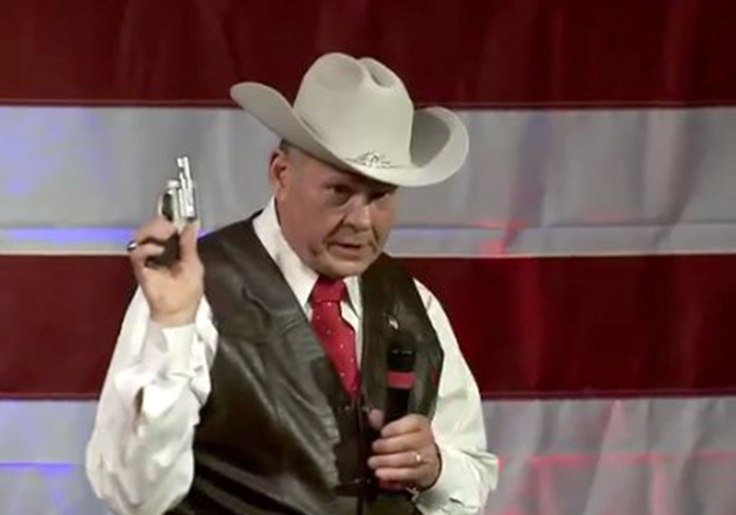
Roy Moore is the Republican candidate for the senate race in Alabama. Moore has been accused of sexual misconduct by at least nine women. The allegations range from harassment to sexual assault. Some of the women were minors at the time that these incidents occurred (and Moore was in his thirties). Moore denied the allegations. Republicans have had to decide whether or not to support, or endorse, or denounce Moore. Reactions have varied.
Many Republicans are standing by their man. Part of their reasoning? Tribal, evangelical, Christianism.
Moore’s Alabama senate run has exposed the ignorance (both coincidental and willful) that exists within segments of the Religious Right. In the case of Moore, his supporters are doing everything they can to defend their man. Some claim the allegations against Moore are fake news. One supporter implied that one of Moore’s accusers was paid $50,000 to lie about him. When the Moore supporter was challenged on this, he admitted that he just made it up. But the sentiment that this whole scandal (or these nine whole scandals) is just political conspiracy is strong with many who stand for Moore. Some admit that these women could be credible, but that that possibility in no way shakes their support for him. Because the Moore supporters are Christian, and he is a Christian too, apparently.
The case of Moore is a microcosm of the ongoing national crisis of Christianity in American politics. I listened to a radio program a few weeks ago where evangelical James Dobson (of Family Talk) was interviewing Stephen E. Strang about his book God and Trump. In the interview, Dobson (referring to a meeting that he and other Christian leaders had with Donald Trump) said: “What we saw there gave us permission to vote for somebody that we knew was not probably a born again Christian. Now only God knows. He claims to be deeply committed to Christ and I believe that… Who knows, God knows. But he is certainly trying to do the things that would please us I can tell you that.” There seems to be an equation of “I say I’m Christian, you say you’re Christian, you say you want to do what I want you to do so… you have passed my Christianism test and must have my support.”
This is nonsense, but apparently it is not apparently nonsense. Many in America have forgotten that the test of Christianity is Christ-likeness, not kingdom-of-this-world political affiliation or policy standpoints.
It is incredibly frustrating to hear people misrepresenting Christ. I used to feel embarrassed when scandals or controversies like this occurred. But I look at Christ in the scriptures. There are numerous accounts of him dealing with similar situations. When he drives the money changers from the temple, when he comes to the defense of the woman caught in adultery, when he tells some of the Jewish theologians that they are children of Satan and not of God based on their actions, he is setting the record straight, separating Yahweh from the actions and attitudes of those who claim his name. He saw these opportunities as teaching moments. It is the same for us now.
Jesus was a Jew living under Roman rule. He was part of a politically, economically, and socially oppressed class “from the hood part of town,” as KB puts it (“New Portrait”) Shane Claiborne’s Jesus for President goes a little deeper. People of privilege miss what a big deal this is. When the Jews attempted to stand and fight for their rights, the Romans sent in the Peacekeepers, and they crucified people. Jesus’ people. Jesus could have tried to take political power. Instead he chose to serve God and walk with the poor and the abused and tell them that they are loved, show them that God’s heart is for them. That is Christ likeness.
It is wrong to equate political power in the kingdom-of-this-world with Christlikeness. Political power does not make one Christ-like. Being like Christ makes one Christ-like, with actual examples from the life of Christ. And while these false pictures of Christians come up in our political seasons, they also offer us a chance to speak truth, and for that, I am thankful. Because when it comes to learning about Christ, there is always a need for more.
 Festival of Booths
Leave a comment